
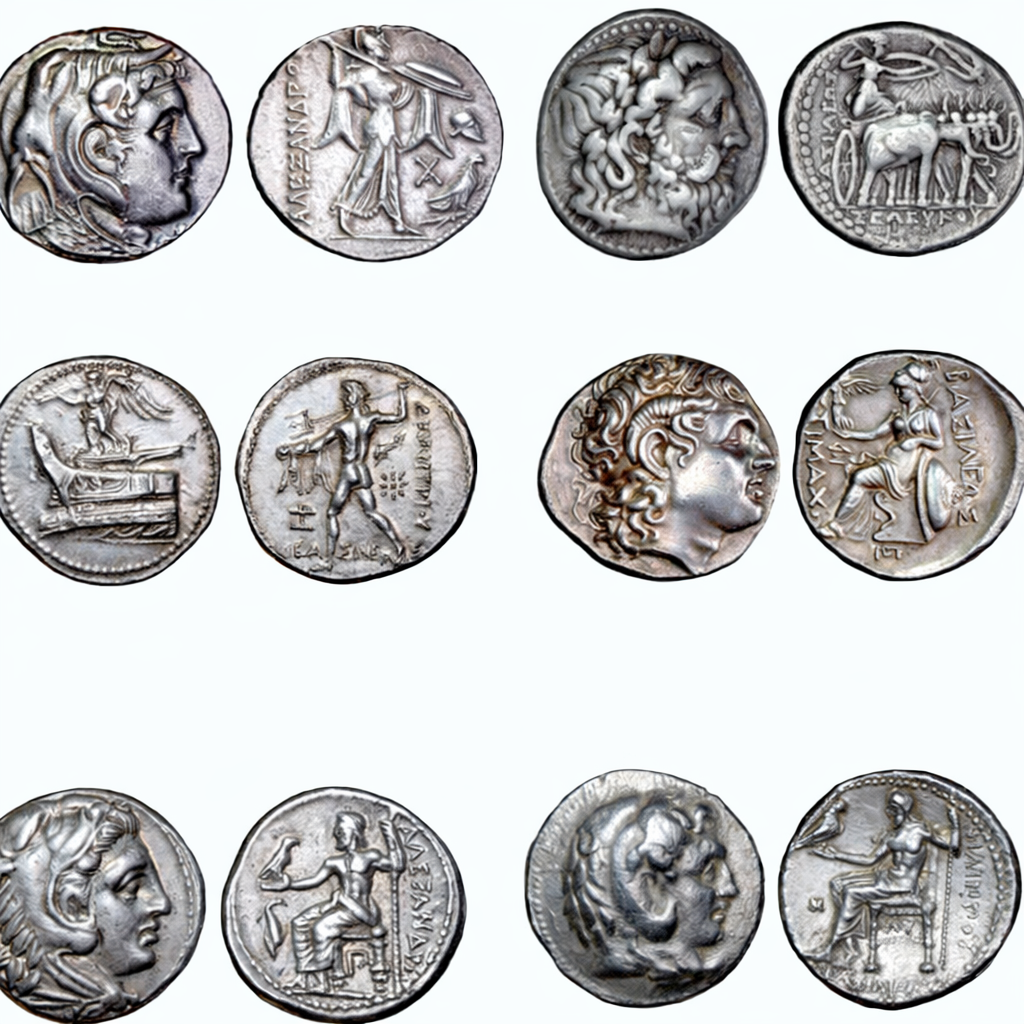
Hellenistic Successors (Diadochi) Coins
From Alexander’s Legacy to New Kingdoms
Introduction: When Alexander’s Empire Became Many Kingdoms
After the death of Alexander the Great in 323 BCE, his empire did not pass to a single heir. Instead, it fractured into competing kingdoms ruled by his generals — the Diadochi (“successors”).
Coinage became one of the most powerful tools in this struggle. At first, the successors struck coins in Alexander’s name to legitimize their rule. Gradually, they replaced Alexander’s imagery with their own portraits, symbols, and dynastic identities, creating the rich and complex field known as Hellenistic coinage.
This page is the master pillar for understanding Diadochi coins and how they evolved from Alexander’s monetary system.
1. Who Were the Diadochi?
The Diadochi were Alexander’s generals and companions who divided his empire after his death. The most important for coinage are:
-
Ptolemy I Soter (Egypt)
-
Seleucus I Nicator (Asia & Near East)
-
Lysimachus (Thrace & Asia Minor)
-
Antigonus I Monophthalmus (Asia Minor)
Each founded a dynasty, and each used coinage to claim legitimacy.
2. Phase One: Coins in the Name of Alexander
Immediately after 323 BCE, most successors continued striking:
-
Herakles / Zeus tetradrachms
-
Legend ΑΛΕΞΑΝΔΡΟΥ
Why?
-
Alexander’s name guaranteed trust
-
Armies and markets recognized the type
-
Political stability required continuity
These are called posthumous Alexander issues, and they form the bridge between Macedonian and Hellenistic coinage.
👉 Context pillar:
/alexander-the-great-coins/
/alexander-tetradrachm-monograms/
3. Phase Two: Transition Coinage (Shared Authority)
As power stabilized, successors began to:
-
add personal symbols
-
introduce new reverse types
-
subtly adjust portrait styles
Coins from this phase often still name Alexander but show regional identity, making attribution complex and fascinating.
This is one of the most challenging — and rewarding — areas for collectors.
4. Phase Three: Independent Dynastic Coinage
Eventually, successors replaced Alexander entirely.
Major Innovations
-
Realistic royal portraits (first in history)
-
Dynastic symbols
-
Explicit royal titles (ΒΑΣΙΛΕΩΣ)
This marks the birth of true Hellenistic royal coinage.
5. Major Diadochi Coin Types
Lysimachus
-
Deified Alexander portrait with horn of Ammon
-
Athena Nikephoros reverse
-
One of the most beautiful coinages of antiquity
Ptolemaic Kingdom (Egypt)
-
Heavy silver tetradrachms
-
Eagle on thunderbolt
-
Closed monetary system
Seleucid Empire
-
Apollo on omphalos
-
Anchors as dynastic symbol
-
Vast mint network
Antigonid Macedon
-
Continuation of Macedonian traditions
-
Royal portraits and military symbolism
Each system evolved differently despite shared origins.
6. Legends, Language, and Titles
Hellenistic coins typically use:
-
Greek language
-
Royal genitive forms (e.g. ΒΑΣΙΛΕΩΣ ΣΕΛΕΥΚΟΥ)
-
Clear assertion of kingship
This is a shift from Alexander’s implicit authority to explicit monarchy.
👉 Reading guide:
/greek-coin-legends-explained/
7. Mints and Geography
Diadochi coinage was struck across:
-
Greece
-
Asia Minor
-
Syria
-
Egypt
-
Mesopotamia
Unlike Alexander’s centralized types, Diadochi mints show regional style differences, aiding attribution.
8. Dating Diadochi Coins
Dating depends on:
-
ruler named
-
portrait style
-
control symbols
-
historical reign dates
Unlike Alexander coins, Diadochi issues are often more precisely dated.
9. Rarity, Survival, and Collecting Today
Diadochi coins range from:
-
common silver tetradrachms
-
to extremely rare early royal issues
Collectors value them for:
-
artistry
-
historical narrative
-
dynastic continuity
They form the bridge between Greek and Roman imperial coinage.
10. Why Diadochi Coins Matter
Diadochi coins introduced:
-
realistic ruler portraits
-
dynastic branding
-
personal kingship on money
Every later imperial coinage — including Roman emperors — follows this model.
Final Thoughts: The Birth of Royal Portrait Coinage
The Diadochi did more than divide Alexander’s empire — they invented a new language of power through coinage.
From Alexander’s idealized hero to living kings with human faces, Hellenistic coins document the moment when rulers first looked directly out from their money.
That legacy still defines coinage today.