
Byzantine Coin Identification Guide: Legends, Crosses, and Emperors
Byzantine coins often confuse collectors at first. The portraits look stiff, the letters seem strange, and the symbols feel unfamiliar — crosses, large letters, and religious imagery everywhere.
But once you understand what to look for, Byzantine coin identification becomes surprisingly logical.
This guide will show you how to identify Byzantine coins step by step, even if you’ve never handled one before.
🏛️ What Makes a Coin “Byzantine”?
Byzantine coins belong to the Eastern Roman Empire, roughly from AD 491 to 1453.
They are different from earlier Roman coins because:
-
Christianity replaces pagan gods
-
Portraits become frontal and symbolic
-
Letters often mix Greek and Latin
-
Coins focus more on faith and authority than realism
If your coin feels religious, symbolic, and formal, you’re likely looking at a Byzantine issue.
🔍 Step 1: Look at the Portrait Style
Byzantine portraits are very distinctive.
Common features:
-
Facing forward, not in profile
-
Stiff, flat appearance
-
Large eyes
-
Simplified facial details
Early Byzantine coins may still look Roman, but later coins abandon realism completely. This is one of the strongest identification clues.
✝️ Step 2: Identify Christian Symbols
Christian symbolism is the heart of Byzantine coinage.
Common symbols include:
-
Crosses (simple or ornate)
-
Cross on steps
-
Globus cruciger (orb with a cross)
-
Christograms (Chi-Rho)
If your coin shows a cross instead of a god, you are no longer in pagan Rome.
👉 These symbols help distinguish Byzantine coins from Roman ones instantly.
✍️ Step 3: Examine the Legends (Letters)
Byzantine legends can look confusing, but there are patterns.
What to look for:
-
Greek letters (Α, Δ, Μ, Ν)
-
Short inscriptions
-
Religious phrases
-
Emperor names abbreviated
Unlike Roman coins, Byzantine legends are often less readable but more symbolic.
👉 For help, see Ancient Coin Legends Explained.
🪙 Step 4: Identify the Metal and Size
Most Byzantine coins you’ll encounter are bronze.
The most common denomination:
-
Follis (large bronze coin)
Typical features:
-
Thick flan
-
Dark patina
-
Large central letter on the reverse
Gold and silver Byzantine coins exist, but bronze is by far the most common and beginner-friendly.
🔠 Step 5: Decode the Large Letters (M, K, I, E)
One of the easiest Byzantine features to recognize is the large letter on the reverse.
These letters indicate value:
-
M = 40 nummi
-
K = 20 nummi
-
I = 10 nummi
-
E = 5 nummi
If your coin has a huge letter dominating the reverse, that’s a classic Byzantine identifier.
🗺️ Step 6: Look for Mint Marks
Byzantine coins often include mint information.
You may see:
-
Letters at the bottom of the reverse
-
City abbreviations
-
Workshop marks
This helps identify where the coin was made, such as Constantinople or other imperial mints.
🧠 Step 7: Understand the Religious Message
Byzantine coins were not about personality — they were about divine authority.
The message was:
The emperor rules by the will of God.
That’s why:
-
Christ appears on later coins
-
Emperors look symbolic, not human
-
Crosses dominate the design
This mindset shift is key to understanding Byzantine coinage.
⚠️ Step 8: Common Beginner Mistakes
Avoid these:
❌ Expecting realistic portraits
❌ Confusing Byzantine coins with medieval tokens
❌ Ignoring large letters on the reverse
❌ Cleaning bronze coins aggressively
Dark patina is normal and desirable on Byzantine bronze.
🧪 Step 9: Basic Authenticity Check
Fake Byzantine coins exist, but many originals are:
-
Crude
-
Off-center
-
Irregular
Signs of authenticity:
-
Natural wear
-
Uneven strike
-
Thick flan
Perfectly smooth, shiny Byzantine coins are often suspicious.
🔎 Step 10: How Byzantine Coins Fit Into Identification
Byzantine coins act as a bridge between:
-
Roman coinage
-
Medieval coinage
If a coin feels:
-
Roman but Christian
-
Imperial but symbolic
-
Ancient but religious
You’re likely holding a Byzantine coin.
🔗 Continue Learning on NumisHaven
To build confidence:
-
👉 Ancient Coin Identification Guide
-
👉 How to Identify Roman Coins
-
👉 Roman Coin Symbols and Meanings
-
👉 Ancient Coin Legends Explained
Byzantine Coin Symbols Meaning: Crosses, Christograms, and Divine Authority
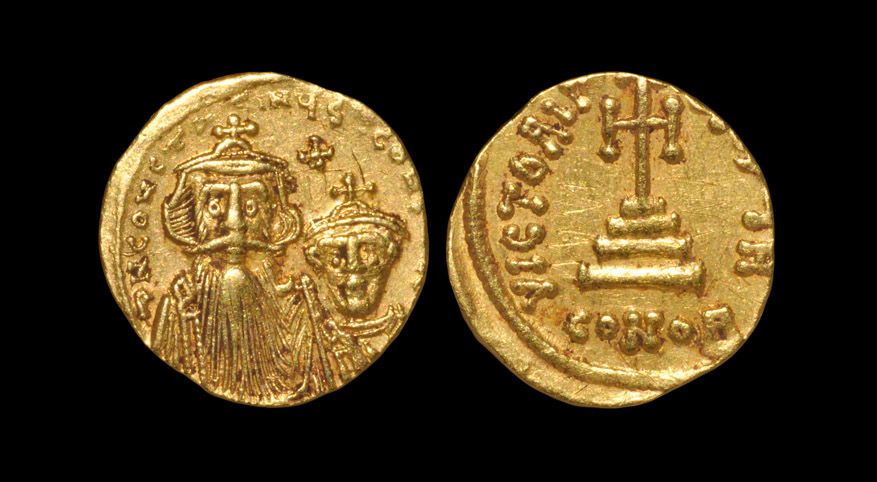
Byzantine coins don’t hide their message. Where earlier Roman coins celebrated victory, power, and gods of war, Byzantine coins speak a different language — faith, divine authority, and Christian rule.
If you’ve ever looked at a Byzantine coin and wondered why everything seems religious, this article will help you understand exactly what those symbols mean and how to use them for identification.
✝️ Why Symbols Are Central to Byzantine Coinage
Byzantine coins were issued in a world where:
-
Christianity was the state religion
-
The emperor ruled by God’s will
-
Coins were tools of faith as much as currency
Symbols were not decoration. They were statements of belief and legitimacy.
✝️ The Cross (Most Common Byzantine Symbol)
Meaning: Christianity, divine authority, God’s protection
The cross is the single most important Byzantine coin symbol.
Common forms include:
-
Simple cross
-
Cross on steps
-
Cross held by the emperor
A cross tells you immediately:
-
The coin is post-pagan
-
It belongs to the Byzantine world
-
The ruler claims divine approval
If you see a cross replacing a Roman god, you’ve crossed into Byzantine territory.
⛪ Cross on Steps
Meaning: Christianity triumphing over the world
This symbol shows a cross standing on one or more steps.
It represents:
-
The victory of Christianity
-
The foundation of faith
-
Stability of the Christian empire
Coins with a cross on steps often date to middle Byzantine periods and are very common on bronze issues.
☧ Chi-Rho (Christogram)
Meaning: Christ, divine protection
The Chi-Rho is made from the first two Greek letters of Christos:
-
Χ (Chi)
-
Ρ (Rho)
This symbol:
-
Appears on late Roman and early Byzantine coins
-
Marks the transition from pagan to Christian coinage
-
Signals divine endorsement of the emperor
Seeing a Chi-Rho usually places a coin around the early Christian era.
🌍 Globus Cruciger (Orb with Cross)
Meaning: Christ rules the world
The globus cruciger is a globe topped with a cross.
It symbolizes:
-
Christ’s dominion over Earth
-
The emperor ruling as God’s representative
-
Universal Christian authority
When an emperor holds this object, the message is clear:
Power comes from God, not the people.
👑 Emperor Holding a Cross
Meaning: Sacred kingship
Many Byzantine coins show the emperor:
-
Holding a cross
-
Standing beside Christ
-
Receiving authority from Christ
This imagery reinforces the idea that the emperor is chosen by God, not simply a political leader.
These coins are powerful indicators of Byzantine ideology.
🔠 Large Letters (M, K, I, E)
Meaning: Coin denomination
One of the most practical Byzantine symbols is the large letter on the reverse.
These letters represent value in nummi:
-
M = 40 nummi
-
K = 20 nummi
-
I = 10 nummi
-
E = 5 nummi
If your coin has a giant letter dominating the reverse, it is almost certainly Byzantine bronze.
👉 See more in Byzantine Coin Identification Guide.
🕊️ Angels and Religious Figures
Meaning: Divine guardianship
Later Byzantine coins sometimes depict:
-
Angels
-
Archangels
-
Christ himself
These figures reinforce:
-
God’s protection of the empire
-
The sacred nature of authority
-
The close link between church and state
Coins showing Christ are among the most iconic Byzantine issues.
🏛️ Inscriptions as Symbols
Byzantine legends often act like symbols rather than readable text.
Common themes:
-
Abbreviated religious phrases
-
Emperor’s name + divine titles
-
Sacred affirmations
You don’t need to read Greek fluently — recognizing the structure is enough.
👉 For help, see Ancient Coin Legends Explained.
⚠️ Common Beginner Mistakes
Avoid these:
❌ Thinking all crosses are medieval
❌ Confusing value letters with initials
❌ Expecting artistic realism
❌ Cleaning bronze coins aggressively
Byzantine coins are meant to look symbolic, not naturalistic.
🔎 How to Use Symbols for Identification
To identify a Byzantine coin:
-
Look for Christian symbols
-
Identify large denomination letters
-
Note portrait style (frontal, stiff)
-
Confirm with legends and mint marks
Symbols usually identify Byzantine coins faster than text.
Final Thoughts
Byzantine coins aren’t meant to impress with beauty — they’re meant to command belief.
Once you learn to read their symbols, letters, and structure, they stop feeling confusing and start making sense as coins of faith, power, and continuity.
And that’s exactly what the Byzantine Empire wanted.