Solidus Coin Constantine the Great
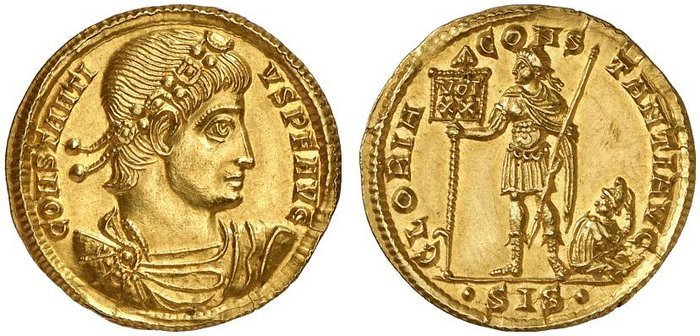
The Birth of the Solidus: Constantine’s Golden Standard
The tale begins with Emperor Constantine the Great (AD 306–337), who understood that the empire needed a new foundation — not only for faith but also for its money. Around AD 310, he introduced the solidus, a finely struck gold coin meant to restore confidence after years of inflation and debasement.
The solidus was a masterpiece of stability — about 4.5 grams of almost pure gold, bearing Constantine’s bold portrait on the front and a symbol of divine favor on the back. It wasn’t just an economic reform; it was a declaration that Rome’s power now stood under the Christian God.
For collectors, early solidi of Constantine and his successors — like Theodosius II or Justinian I — are captivating. Their crisp portraits and confident inscriptions reflect an empire rediscovering its identity. These are coins that still seem to speak, reminding us of the moment when ancient Rome turned toward faith and endurance.
Even the symbols carried meaning. The Chi-Rho (☧) — the first Christian monogram — appeared on Constantine’s issues, representing victory under the sign of Christ. Later, Byzantine engravers grew more daring, depicting Christ enthroned or blessing the emperor, blurring the line between religion and rulership.
By the 7th century, emperors such as Heraclius and Constans II even shared the obverse with Christ himself — a powerful image of divine partnership. These coins didn’t just pay for goods; they preached the empire’s message of holy authority wherever they traveled — across Europe, North Africa, and the Near East.
🕊️ Collector’s note: The famous gold coins of Justinian II, showing Christ Pantocrator — “Christ the Almighty” — are among the most treasured pieces of medieval coinage. They combine spiritual depth with remarkable artistry, reminding us that Byzantine gold was as much about faith as it was about power.
The Birth of the Solidus: Constantine’s Golden Standard
The story begins with Emperor Constantine the Great (AD 306–337). Around AD 310, he introduced the solidus, a high-purity gold coin that replaced the unstable aureus of late Rome.
-
Weight: ~4.5 grams of nearly pure gold
-
Purity: 95–98%
-
Design: Bust of the emperor (obverse) and a symbol of divine favor (reverse)
The solidus became the backbone of Byzantine commerce and diplomacy. Its weight and purity remained remarkably stable for over 700 years, a feat unmatched in medieval Europe.
For modern collectors, early solidi of Constantine and his successors (like Theodosius II or Justinian I) are prized for their bold portraits and strong historical ties to the dawn of Christian imperial imagery.
🔗 Internal link suggestion: Explore the Justinian I solidus and its legacy →
✝️ Symbols of Faith: Christianity on Gold
Byzantine coinage reflected the spiritual soul of the empire. The solidus wasn’t just economic — it was theological.
Starting with Justinian I (527–565), Christian imagery appeared prominently:
-
The cross became a central motif on reverses.
-
The Chi-Rho (☧) symbol appeared as early as Constantine’s issues.
-
Later coins depicted Christ himself, enthroned or blessing the emperor.
By the 7th century, emperors like Heraclius and Constans II began sharing the obverse with Christ, symbolizing divine partnership.
This blending of religion and rulership made Byzantine coinage a form of visual propaganda — spreading the emperor’s legitimacy across Europe, North Africa, and the Near East.
🕊️ Collector’s note: Coins depicting Christ Pantocrator (especially from Justinian II’s reign) are among the most admired in medieval numismatics.
👑 Portraits of Power: Imperial Imagery
Every Byzantine gold coin was an act of imperial messaging. The emperor’s face wasn’t just a likeness — it was a statement of order and divine authority.
Key Features in Imperial Portraiture:
-
Frontal portraits: replacing the side-facing Roman busts, showing spiritual solemnity.
-
Regalia: crowns, globus cruciger (orb topped with a cross), loros (ceremonial robe).
-
Dual portraits: emperors pictured with their heirs or co-rulers (e.g., Constantine IV with his sons).
By studying facial style, inscriptions, and regalia, collectors can identify the reign and even specific mint workshops.
For instance:
-
Justin I & Justinian I (518–565): Bold, classical busts.
-
Heraclius (610–641): Family portraits with sons.
-
Constantine VII (913–959): Refined artistry during the Macedonian Renaissance.
⚖️ The Histamenon and the Hyperpyron: Evolution of a Standard
By the 10th century, the long-standing solidus began to change.
The Histamenon (10th–11th centuries)
-
Thinner and broader than the classic solidus
-
Same weight but slightly reduced purity
-
Frequently cup-shaped (scyphate) to prevent clipping
-
Featured Christ on one side and the emperor on the other
By the 11th century, devaluation pressures led to the hyperpyron, introduced by Alexios I Komnenos (1081–1118).
-
Weight: ~4.45 g
-
Purity: ~90%
-
Iconography: Highly refined, with elaborate Christ portraits and detailed loros garments
Despite inflation and invasions, the Byzantine gold coin retained symbolic supremacy across Europe. Western kingdoms imitated its style, and Islamic caliphates respected its weight standard.
🏙️ The Mints of the Empire
While Constantinople was the empire’s primary mint, others operated during regional campaigns and expansions.
| Mint | Location | Notes |
|---|---|---|
| Constantinople | Modern Istanbul | Main mint, most abundant issues |
| Thessalonica | Northern Greece | Secondary mint, local circulation |
| Ravenna | Italy | Early imperial issues |
| Syracuse | Sicily | Key for western trade routes |
| Nicomedia | Asia Minor | Common under early Byzantine rule |
| Antioch | Syria | Eastern mint, often stylistically distinct |
Identifying mints relies on tiny mint marks (e.g., CONOB = Constantinople, THEUP = Thessalonica). These abbreviations often appear beneath the figure on the reverse.
Collector tip: Early solidi from peripheral mints like Ravenna or Syracuse often have slight stylistic differences — charming imperfections that make them desirable to advanced collectors.
💎 Collecting Byzantine Gold: Value and Rarity
Byzantine gold coins appeal to both historians and investors because they combine intrinsic gold value with artistic and historical significance.
Factors Affecting Value:
-
Emperor rarity: Short reigns (e.g., Phocas, Justin II) command premiums.
-
Condition: Sharp detail, centered strike, and original luster.
-
Iconography: Christ portraits, dual emperors, or unique symbols increase desirability.
-
Mint and provenance: Constantinople issues are common; provincial mints are rarer.
| Type | Typical Range (USD) | Notes |
|---|---|---|
| Early Solidus (4th–6th c.) | $600–$1,500 | Common, historically important |
| Justinian II Christ Portrait | $1,200–$3,000 | First depiction of Christ |
| Histamenon Nomisma | $800–$2,000 | Thinner, transitional form |
| Hyperpyron of Alexios I | $700–$1,400 | Distinct cup shape |
| Rare Emperor (e.g., Mezezius, Basiliscus) | $5,000+ | Exceptional rarity |
🔗 Internal link suggestion: View the Top 25 Byzantine Gold Coins Catalogue →
🕍 Faith and Artistry: The Dual Legacy
Unlike most currencies that vanish with time, Byzantine gold transcended economics. It carried theology in metal form — Christ blessing emperors, angels crowning rulers, and Latin replaced by Greek as faith redefined empire.
Even today, these coins remain miniature icons of devotion and power. Their survival in pristine condition is a miracle of both craftsmanship and belief.
For collectors, holding a Byzantine solidus feels like touching the divine economy — a sacred handshake between heaven and empire.
🪙 Suggested Public Domain Image Sources
-
Justinian I Solidus: Wikimedia Commons
-
Heraclius Solidus with Sons: British Museum
-
Hyperpyron of Alexios I Komnenos: Metropolitan Museum of Art
All listed sources are safe for educational and commercial reuse (public domain or CC0).
📖 Conclusion: Eternal Light in Gold
The Byzantine solidus outlasted dynasties, invasions, and plagues. For nearly a millennium, it defined what honest money looked like — a reflection of both earthly rule and divine grace.
Today, collectors preserve that legacy. Every Byzantine gold coin in a display case is a gleaming echo of Constantinople’s glory — a coin struck not only with the emperor’s seal but with faith itself.
Written by Irfan Spahillari – NumisHaven
Ancient Coins | Faith & Empire | History in Gold
Internal Links to Add:
-
/byzantine-coins/– Main Byzantine category -
/justinian-i-coins/– Emperor article -
/top-25-byzantine-gold-coins/– Catalogue page -
/coin-values/– Reference for collectors